




Slide Version
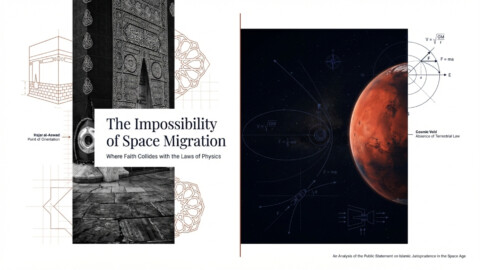
Muslims cannot travel to other planets or outer space—The full scope of the “Impossibility of Space Migration” theory where faith and the laws of physics collide.
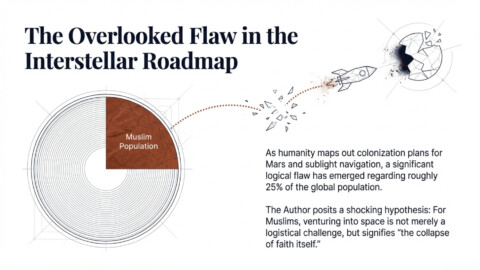
In this modern age where humanity has begun mapping out realistic roadmaps for Mars colonization and interstellar travel via sublight navigation, a significant logical flaw has emerged. It is the shocking hypothesis that for Muslims—who constitute roughly a quarter of the world's population—“venturing into space signifies the collapse of faith itself.”
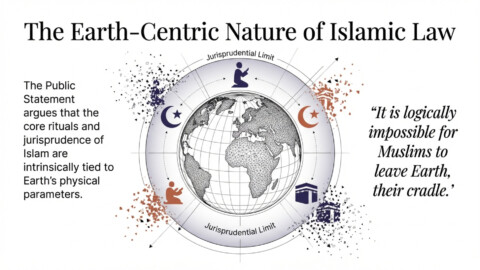
This paper examines the core rituals and jurisprudence of Islam alongside the laws of cosmology, providing a multifaceted and detailed analysis of why it is logically impossible for Muslims to leave Earth, their cradle.
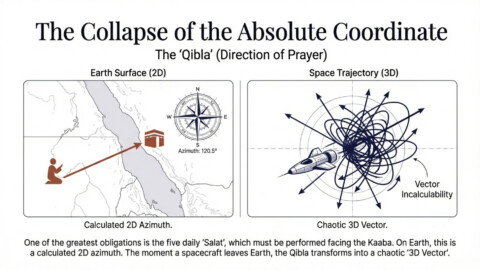
1. The Collapse of the Absolute Coordinate “Qibla (Direction of Prayer)”
One of the greatest obligations imposed on Muslims is the five daily “Salat (Prayer)”. This prayer must be performed precisely facing the direction (Qibla) of the Kaaba shrine in Mecca, Saudi Arabia.
3D Vector Incalculability
On Earth's surface, the Qibla is resolved using a two-dimensional azimuth (degrees from north). However, the moment a spacecraft leaves Earth, the Qibla becomes a “3D vector.”
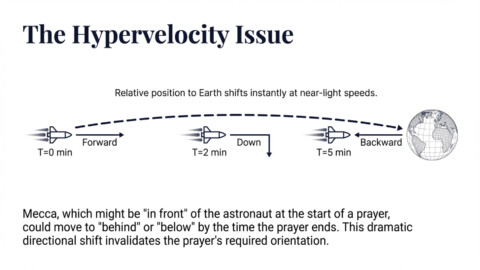
- Dramatic Directional Shift Due to Hypervelocity Travel: When a spacecraft cruises at near-light speeds (several percent of the speed of light or more), its relative position to Earth changes constantly. Mecca, which was “in front” at the start of prayer, will have moved to ‘behind’ or “below” by the time the several-minute prayer ends.
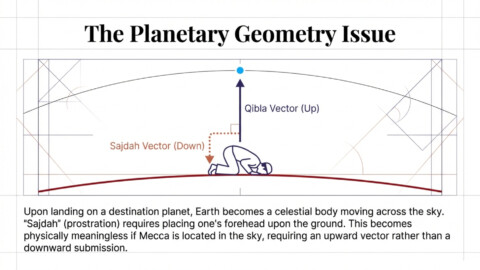
- Effects of Planetary Rotation and Revolution: Upon landing on a destination planet, Earth itself becomes the celestial body moving across the sky. To face Mecca, one must constantly tilt their body in sync with the planet's rotation and occasionally prostrate themselves facing the ground (toward the planet's core). This significantly undermines the spiritual and physical meaning of sajdah (prostration), which involves “placing one's forehead upon the earth.”
2. 【Logical Verification】The Sophistry of Treating “Certified Documents as Mecca”
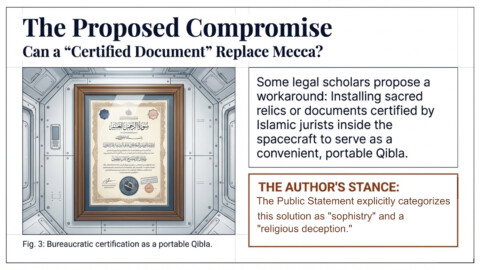
When venturing into space, some legal scholars may propose a compromise: “Install documents or sacred relics certified by Islamic jurists inside the spacecraft, designate them as a convenient Mecca (qibla), and pray towards them.” However, this must be deemed religious deception and blatant sophistry for the following reasons.
Denial of the Physical Location of Holiness
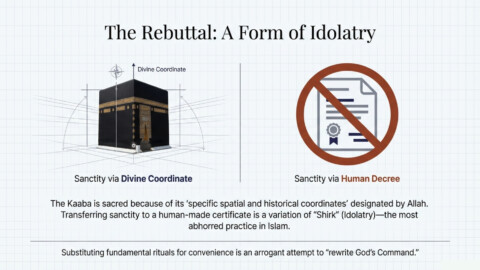
The Kaaba is considered sacred precisely because holiness resides in its “specific spatial and historical coordinates”—the place Abraham built it and Allah designated. Transferring that sanctity to “documents” or ‘certificates’ issued for human convenience is a variation of “idolatry (shirk)”—the most abhorred practice in Islam—and falls into the error of deifying specific objects.
Rewriting “God's Command” for Convenience
The legal principle (rukhsa) allowing simplification in difficult circumstances is intended solely for temporary emergencies on Earth (such as illness or travel). In the permanent context of interplanetary migration spanning generations, substituting fundamental rituals with “documents” is an arrogant attempt to ignore God-ordained physical constraints and redesign religion to suit human convenience. If this were permitted, the very concept of the qibla would become unnecessary, leading to the complete collapse of Islam's ritual system.
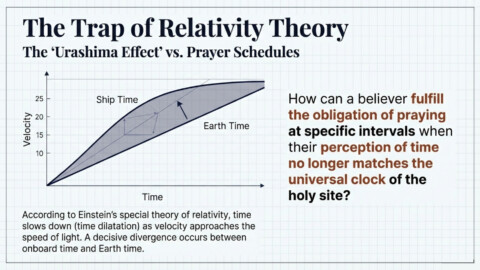
3. The Trap of Relativity Theory: How Time Dilatation Invalidates Obligations
According to Einstein's special theory of relativity, the closer an observer's velocity approaches the speed of light, the more their time slows down (time dilatation). This fundamentally undermines the concept of “time” as a religious obligation.
The Urashima Effect and the Paradox of Prayer Frequency
Inside a sublight spacecraft, a decisive divergence occurs between onboard time and Earth time.
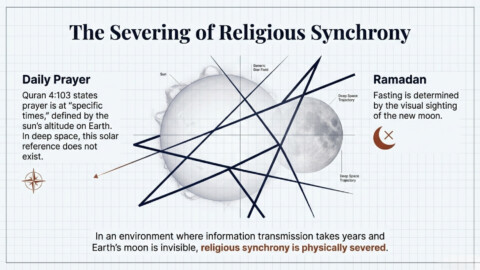
- Loss of the Definition of Time: The Quran states, “Prayer is prescribed for the believers at specific times (4:103).” This “time” refers to the sun's altitude based on Earth's rotation. In a star system where Earth's sun does not exist, there is no legal basis whatsoever for fulfilling this sacred command.
- The Collapse of Ramadan (Fasting): The start and end of fasting are determined by the visual sighting of the new moon. But how can a Muslim traveling at near-light speed ascertain the current lunar phase on Earth? In an environment where information transmission takes years, religious synchrony is physically severed.
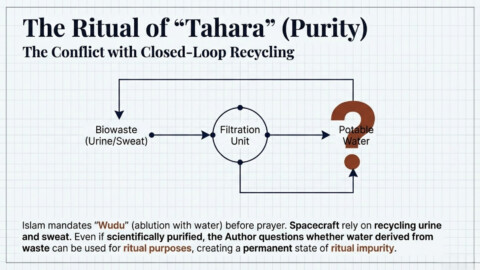
4. The Ritual of “Tahara” (Purity) and the Conflict with Closed-Loop Recycling
In Islam, performing ‘Wudu’—ritual ablution with water—before prayer is mandatory.
Is recycled water “pure”?
Inside spacecraft, urine and sweat are highly filtered for reuse. Even if scientifically purified, debate remains over whether something once waste can be used for ritual purposes.
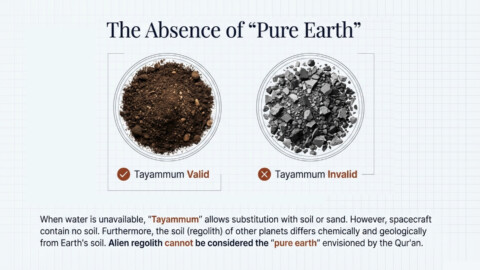
- Absence of Tayammum (Substitution with Sand): Soil or sand can substitute for water when unavailable, but there is no soil inside spacecraft. The soil (regolith) of other planets differs in composition from Earth's soil and can hardly be considered the “pure earth” envisioned by the Qur'an.
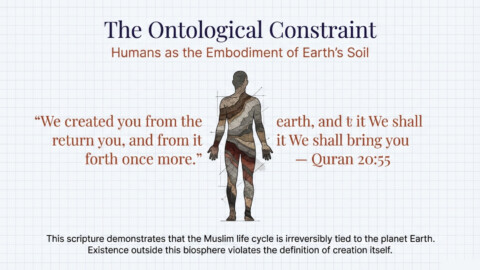
5. Ontological Constraint: Humans are the embodiment of “earth's soil”
The Qur'an (20:55) states: “We created you from the earth, and to it We shall return you, and from it We shall bring you forth once more.”
The Obligation to Return to Earth
This passage demonstrates that the Muslim life cycle is irreversibly tied to the planet Earth.
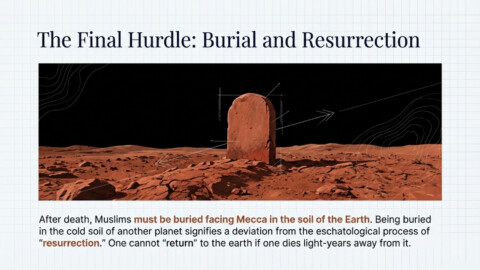
- Burial and Resurrection: After death, Muslims must be buried facing Mecca in the soil of the Earth. Being buried in the cold soil of another planet signifies a deviation from the process of “resurrection” in eschatology.
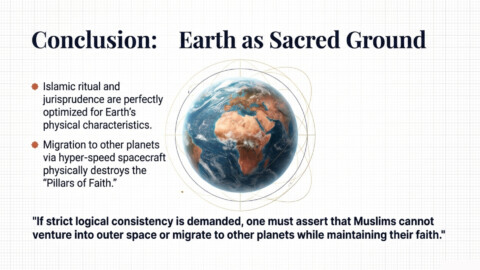
Conclusion: Earth as Sacred Ground
As the above analysis clearly demonstrates, Islamic ritual and jurisprudence are perfectly optimized for Earth's physical characteristics.
Even if some jurists attempt to justify space colonization using the expedient of “substitution by document,” this amounts to nothing more than sophistry that ignores both physical laws and scriptural texts. Migration to other planets via hyper-speed spacecraft constitutes an act that physically destroys all the “Pillars of Faith” for Muslims. Therefore, if strict logical consistency is demanded, one must assert that “Muslims cannot venture into outer space or migrate to other planets while maintaining their faith.”