



Slide Version

1. Introduction: The Divergence of 24th-Century Technology and 1960s Aesthetics
1.1 Background and Objective
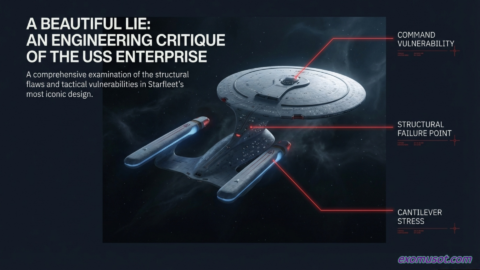
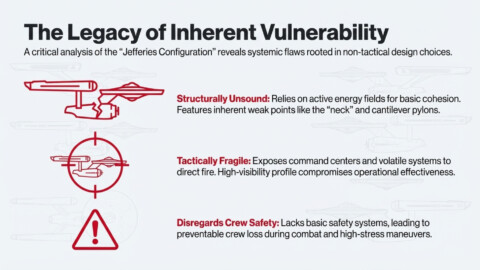
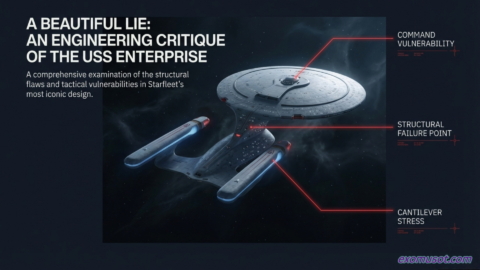
The starships of the United Federation of Planets—specifically the Constitution-class (NCC-1701) and the Galaxy-class (NCC-1701-D)—stand as cultural icons of human spaceflight. However, when evaluated through the lens of mechanical engineering, naval architecture, and military tactics, these designs exhibit fundamental flaws. This report critically examines the structure of "Enterprise-style" vessels against the standards of modern aerospace engineering and weapon systems. It highlights how design constraints from 1960s television production 1 have been maintained as "future technology," creating a lineage of ships that are structurally unsound and tactically fragile.
1.2 The "Jefferies Configuration"
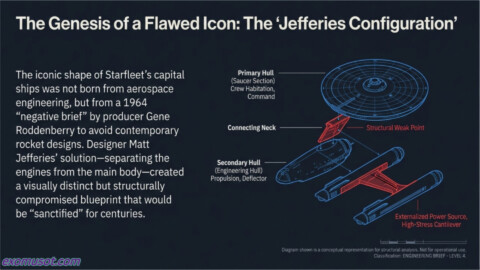
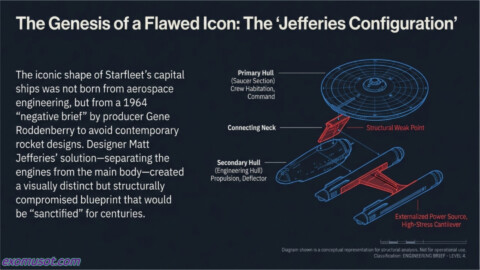
The focus of this analysis is the standard Starfleet layout established by Matt Jefferies, characterized by:
- Primary Hull (Saucer): Command and habitat.
- Secondary Hull (Engineering): Main reactor and deflector.
- Connecting Dorsal (Neck): A thin vertical connector.
- Warp Nacelles: Propulsion units extended away from the body on pylons.
This configuration arose from Gene Roddenberry's "negative brief" in 1964, which forbade rockets, wings, or jets to distinguish the show from Buck Rogers.2 While visually distinct, this resulted in an engineering paradox: detaching the primary propulsion from the main mass of the vehicle.
2. Structural Analysis: The Nightmare of Cantilevers and Stress Concentrations
2.1 Center of Mass vs. Center of Thrust
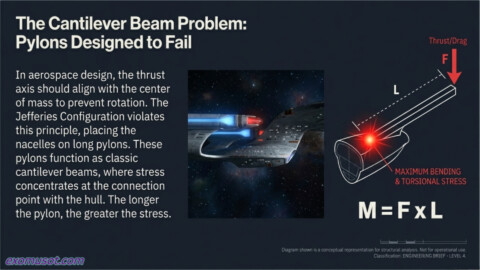
A fundamental principle of aerospace design is aligning the thrust axis with the center of mass (CM) to prevent unwanted rotation.3
- The Offset Problem: On the original Enterprise, the warp nacelles are located high above the ship's likely center of mass. Firing the engines would create a massive downward torque, forcing the ship to nose-dive unless constantly counteracted by maneuvering thrusters or "subspace field geometry" hand-waving.
- Galaxy Class Attempt: Andrew Probert, designer of the Enterprise-D, recognized this flaw and lowered the nacelles to sit between the saucer and engineering hull to bring the thrust axis closer to the CM.4 However, the engines remain external, creating significant moment arms.
2.2 Pylons as Cantilever Beams
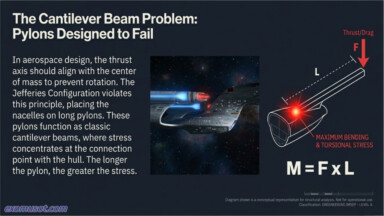
The pylons supporting the heavy warp nacelles function as cantilever beams.5
- Moment Load: The connection point where the pylon meets the hull is subjected to extreme bending moments ($M = Force \times Distance$). The longer the pylon, the greater the leverage.
- Vibration and Fatigue: During combat maneuvers or high-impulse turns, these pylons act like tuning forks. The oscillating loads would likely cause catastrophic fatigue failure in physical materials 7 without the magical intervention of force fields.
2.3 The "Neck" Vulnerability
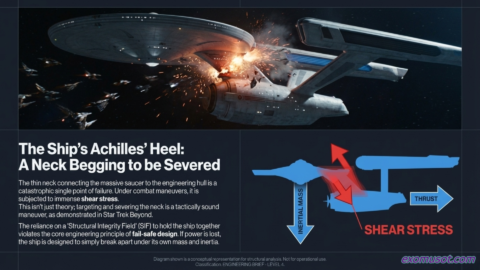
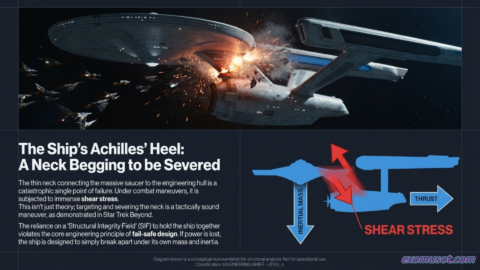
The connecting dorsal (neck) on ships like the Constitution and Galaxy class is a structural choke point.8
- Shear Stress: The neck connects the massive saucer to the massive engineering hull. Under acceleration, the neck is subjected to immense shear and tensile stress.
- The "Decapitation" Risk: As seen in Star Trek Beyond, severing this thin connection effectively destroys the ship. It is a structural weak point that invites enemy fire, offering no redundancy.
2.4 Reliance on the Structural Integrity Field (SIF)
Starfleet attempts to explain away these impossible structures using the Structural Integrity Field (SIF).10
- Lack of Fail-Safe: Good engineering requires a "fail-safe" design—if the active safety system fails, the structure should remain stable. Starfleet ships are "fail-deadly." If power is lost, the SIF collapses, and the ship can tear itself apart under its own inertia.10 Relying on a powered field to keep the ship from crumbling is a violation of basic safety engineering.
3. Tactical Analysis: The "Shoot Me" Design Philosophy
3.1 The Bridge: A Target on a Platter
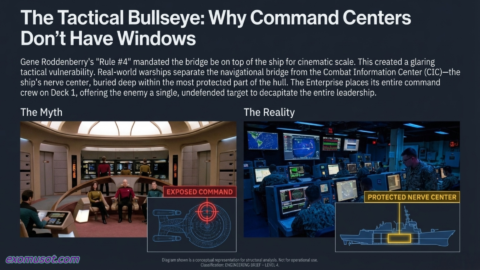
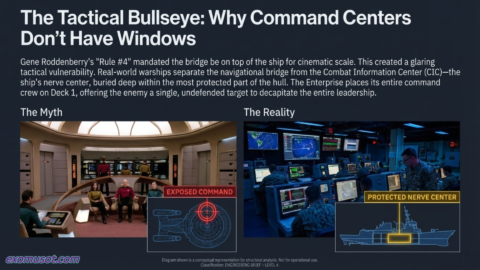
Gene Roddenberry's Rule #4 mandates that "The bridge must be located at the top center of the primary hull".12
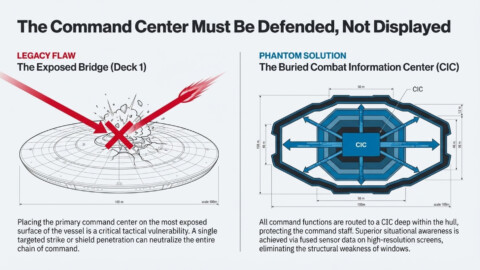
- Zero Protection: The command staff (Captain, XO, Helm, Tactical) sits on Deck 1, the most exposed point of the ship, protected only by a window or a dome.14 A single shield penetration or a kamikaze run (as seen in Nemesis) kills the entire chain of command.
- Lack of CIC: Modern warships utilize a Combat Information Center (CIC) buried deep within the hull for protection.14 Starfleet's refusal to adopt a CIC (except on the Defiant or Galactica-style ships) places aesthetics over survivability.
3.2 Windows: Structural Weaknesses
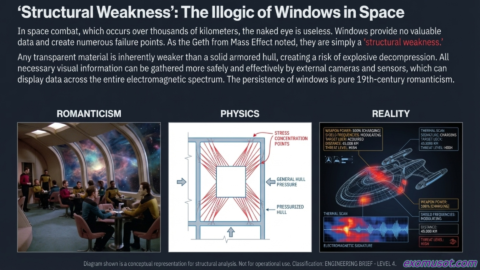
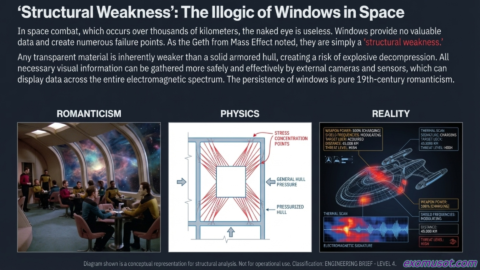
Starships are covered in windows, including skylights on the bridge and panoramic views in quarters[21].
- Glass vs. Armor: Regardless of "transparent aluminum" claims, a transparency creates a material discontinuity and a stress concentration point. In a pressurized vessel, every window is a potential blowout point.
- Tactical Irrelevance: In space combat involving distances of thousands of kilometers, visual confirmation is useless. Windows provide no tactical data that sensors cannot display on a screen, yet they introduce critical vulnerabilities.
- The Pointlessness of Windows in Space:
Windows offering views of outer space are installed everywhere from the lounge to crew quarters. However, over 99% of actual outer space is pitch black, and the scenes of stars streaming by seen in movies and TV series are impossible in reality. Therefore, installing windows serves no purpose.
3.3 Warp Nacelles: Exposed Volatiles
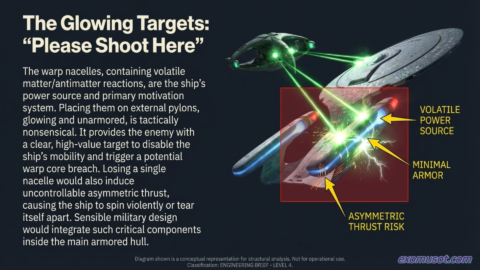
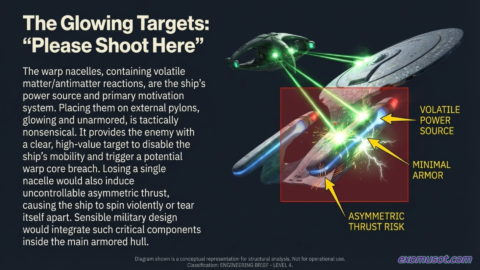
The nacelles are filled with high-energy plasma and warp coils, yet they are extended away from the ship's shields and armor.16
- Disabling the Ship: An enemy does not need to penetrate the main hull; clipping a pylon or hitting a nacelle cripples the ship's ability to maneuver or escape.
- Asymmetric Thrust: Losing one nacelle would result in uncontrollable asymmetric thrust, sending the ship into a spin.17
4. Mechanisms of Madness: Separation and Transformation
4.1 Saucer Separation: A Tactical Gimmick
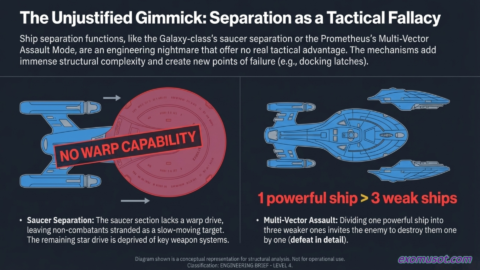
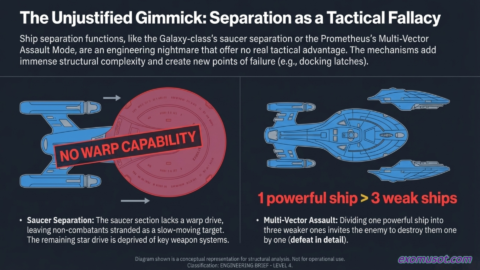
The Galaxy-class's ability to separate is cited as a safety feature for civilians, but it is tactically unsound.
- Stranded Target: The saucer section lacks warp drive. Once separated, it is a sitting duck.
- Structural Nightmare: The mechanism requires massive docking latches and the physical disconnection of plumbing, EPS conduits, and turbolifts. The complexity introduces thousands of failure points. If a latch jams during combat, the ship cannot reconnect or separate.
4.2 Multi-Vector Assault Mode (Prometheus Class)
The Prometheus splits into three sections to attack [22].
- Divide and Conquer (Yourself): Splitting one strong shield bubble into three weaker ones makes the individual sections vulnerable to being picked off one by one.
- Automation reliance: If the computer network is jammed or hacked (a frequent occurrence in Trek), the coordination between sections fails, leading to friendly fire or collisions.
5. Crew Safety: The Absence of Basic Restraints
5.1 No Seatbelts
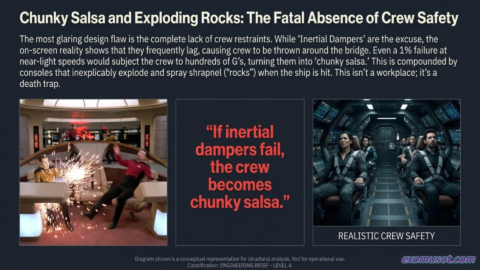
Despite centuries of technological advancement, bridge officers lack simple safety harnesses [15].
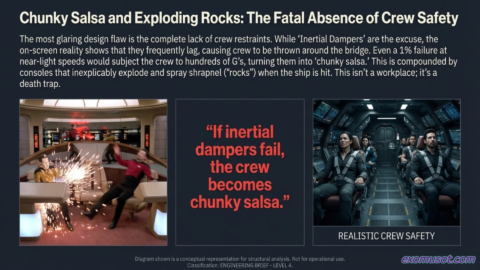
- Inertial Damper Lag: The crew is constantly thrown from their chairs during combat due to "inertial damper lag."
- Physics of Impact: Without dampers, a high-impulse acceleration would liquefy the crew. Even a 1% failure of a 1000g maneuver results in a 10g impact—fatal without restraints. The lack of seatbelts is a flagrant disregard for OSHA standards and crew survival.
5.2 Exploding Consoles
Starfleet routes high-energy Electro-Plasma System (EPS) conduits directly behind user interface panels[23].
- Rocks in the Dash: When the ship takes fire, consoles explode, showering officers with rocks and plasma. Isolating control circuits from power transmission is Electrical Engineering 101, yet Starfleet designs turn every workstation into a claymore mine.
6. Engineering Insanity: The Unshielded Reactor
6.1 The Warp Core "Death Trap"
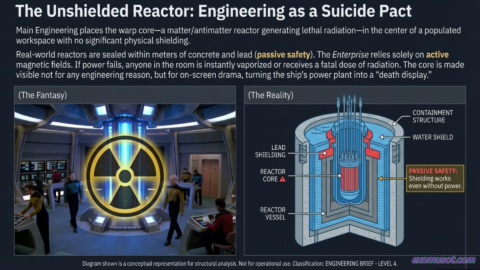
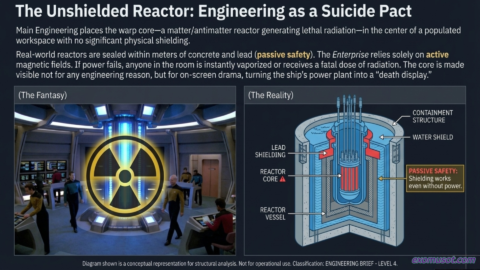
In Main Engineering, the Matter/Antimatter Reaction Assembly (Warp Core) is often a floor-to-ceiling column located in the center of the room.
- Zero Physical Containment: Unlike modern nuclear reactors, which are housed in thick containment vessels and isolated from crew, the Warp Core is protected only by magnetic fields.
- Transparency: The core is often transparent to allow crew (and viewers) to see the "swirling lights." A reactor containing the power of a small star should not be made of glass, nor should it be visible.
- Ejection Failure: The Warp Core Ejection System, the ultimate fail-safe, has a near-100% failure rate in the TNG era.
7. Thermodynamics: The Stealth & Heat Problem
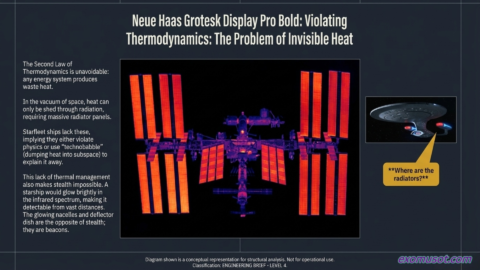
7.1 Where are the Radiators?
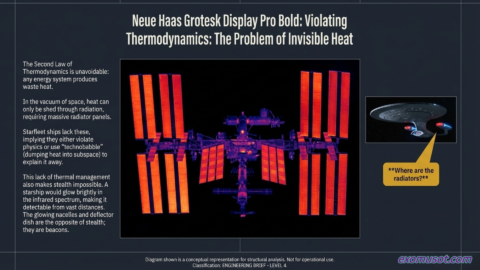
Starships generate petawatts of power but have no visible means of heat dissipation.18
- Thermodynamics Violation: In a vacuum, heat can only be shed via radiation. Realistic ships (like in The Expanse or Avatar) require massive radiator panels. Enterprise hulls are smooth. Without radiators, the ship should cook its crew alive within minutes of engaging the engines.
7.2 Stealth is Impossible
The glowing Bussard collectors and warp grilles make Starfleet ships giant beacons across the electromagnetic spectrum.19 "Stealth" in this configuration is physically impossible; they are visible to passive sensors from light-years away.
8. Conclusion: The Sanctification of Design

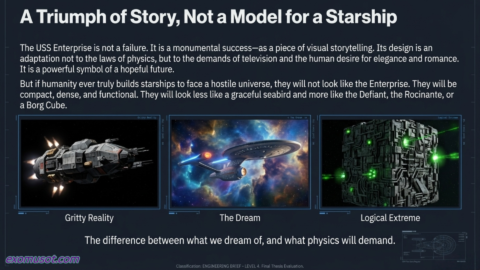
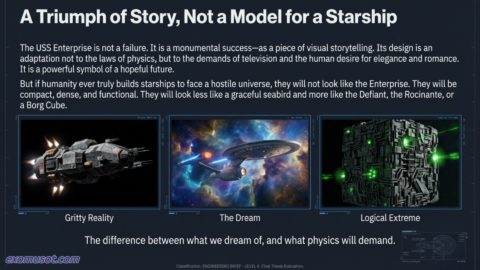
The persistence of these flaws is not due to in-universe logic, but "Sanctification".20 The silhouette of the original Enterprise—saucer, neck, secondary hull, nacelles—has become a religious dogma for the franchise.
- Aesthetics over Function: Designers are forced to adhere to Roddenberry's 1960s rules (nacelles must see each other, bridge on top) 13, preventing the evolution toward realistic military designs like the Defiant or The Expanse's Rocinante.
- The Verdict: While beautiful, the Enterprise is an engineering disaster. It is a ship designed for dramatic television, reliant on "space magic" (SIF, IDF) to exist, and would be instantly destroyed in a conflict governed by real-world physics.
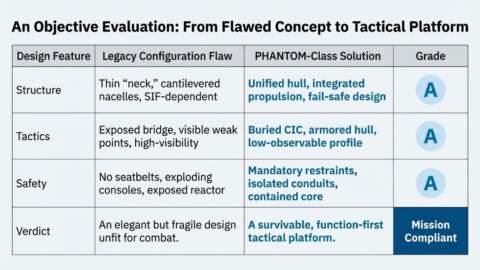
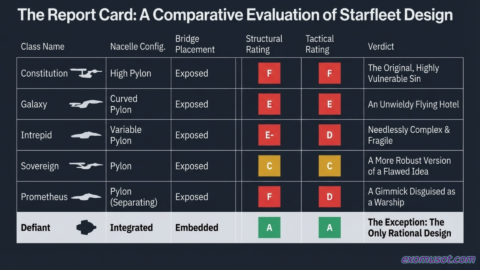
Summary Table: Starship Design Grades
| Class | Structure | Tactics | Safety | Verdict |
| Constitution | F (Thin neck, high nacelles) | F (Bridge exposed) | F (No seatbelts) | A 1950s fantasy of spaceflight. |
| Galaxy | D- (Massive target, complex sep.) | D (Civilian families on board) | F (Exploding rocks) | A luxury hotel built on a bomb. |
| Defiant | B+ (Compact, no neck) | B (Recessed bridge) | C (Still no seatbelts) | The only credible warship. |
| Prometheus | F (MVAM weakens shields) | D (Too complex) | D | A tactical gimmick. |
References
- What is the story behind the design of the first U.S.S. Enterprise in Star Trek? - Quora
https://www.quora.com/What-is-the-story-behind-the-design-of-the-first-U-S-S-Enterprise-in-Star-Trek - Starship Concept Art - Designing the starship Enterprise - FSD
http://fsd.trekships.org/art/1701.html - Is the Enterprise's design Efficient? : r/DaystromInstitute - Reddit https://www.reddit.com/r/DaystromInstitute/comments/2do2fa/is_the_enterprises_design_efficient/
- Designing the Next Generation Enterprise - Forgotten Trek,
https://forgottentrek.com/the-next-generation/designing-the-next-generation-enterprise/ - Discovery AIM tutorial – Analysis of cantilever beam with I cross-section | Ansys Knowledge https://innovationspace.ansys.com/knowledge/forums/topic/discovery-aim-tutorial-analysis-of-cantilever-beam-with-i-cross-section/
- This is how Voyager's movable nacelles work : r/startrek - Reddit https://www.reddit.com/r/startrek/comments/jzyqij/this_is_how_voyagers_movable_nacelles_work/
- Structural Analysis of Pylon Head for Cable Stayed Bridge Using Non-Linear Finite Element Method - ISOMAse.org
https://isomase.org/JOMAse/Vol.51%20Jan%202018/51-1.pdf - USS Enterprise NCC-1701 : analysis
https://www.fantastic-modelers.fr/en/uss-enterprise-ncc-1701-analysis/ - How big of a weakness is a "neck" connecting the saucer and engineering sections? : r/DaystromInstitute - Reddit https://www.reddit.com/r/DaystromInstitute/comments/17tie57/how_big_of_a_weakness_is_a_neck_connecting_the/
- What do they mean when they say "increase structural integrity" or "shunt more power to structural integrity"? That just sounds like "Use power to magically make the hull of the ship harder somehow", and I haven't seen much of an explanation of what is supposedly happening. : r/startrek - Reddit https://www.reddit.com/r/startrek/comments/1nd3c93/what_do_they_mean_when_they_say_increase/
- Technical Manual - Rick Sternbach, Michael Okuda - Google Books https://books.google.com/books/about/Technical_Manual.html?id=po7406HGXQYC
- Starship design rules : r/StarTrekStarships - Reddit
https://www.reddit.com/r/StarTrekStarships/comments/1ae4o9g/starship_design_rules/ - Gene Roddenberry's Four Starship Design Rules For Star Trek, Explained - SlashFilm
https://www.slashfilm.com/1727900/gene-roddenberry-star-trek-starship-design-rules-explained/ - Is the bridge design flawed? : r/DaystromInstitute - Reddit
https://www.reddit.com/r/DaystromInstitute/comments/187wrgh/is_the_bridge_design_flawed/ - Why Starfleet's Bridge Design Was Lethal to the Crews - YouTube
https://www.youtube.com/watch?v=61-jrSK47LY - What are the pros and cons of a starship having warp nacelles? : r/StarTrekStarships - Reddit
https://www.reddit.com/r/StarTrekStarships/comments/17mzwrc/what_are_the_pros_and_cons_of_a_starship_having/ - Detatched Nacelles make no sense. : r/startrek - Reddit
https://www.reddit.com/r/startrek/comments/1dja75a/detatched_nacelles_make_no_sense/ - On Starship Thermal Management : r/DaystromInstitute - Reddit
https://www.reddit.com/r/DaystromInstitute/comments/u01t0l/on_starship_thermal_management/ - Spaceships of the Expanse | Joseph Shoer
http://josephshoer.com/blog/2015/06/spaceships-of-the-expanse/ - Sci Fi Archives - Page 3 of 35 - Open Culture
https://www.openculture.com/category/sci_fi/page/3 - [Sci-fi general] Why are bridges located at a vulnerable spot on a ship? : r/AskScienceFiction
https://www.reddit.com/r/AskScienceFiction/comments/12hcsa0/scifi_general_why_are_bridges_located_at_a/ - What are the advantages of Multi-vector Assault mode? : r/DaystromInstitute - Reddit
https://www.reddit.com/r/DaystromInstitute/comments/3c78nf/what_are_the_advantages_of_multivector_assault/ - How would an actual starship bridge function differently than Star Fleets? - Reddit
https://www.reddit.com/r/DaystromInstitute/comments/1cba0xs/how_would_an_actual_starship_bridge_function/
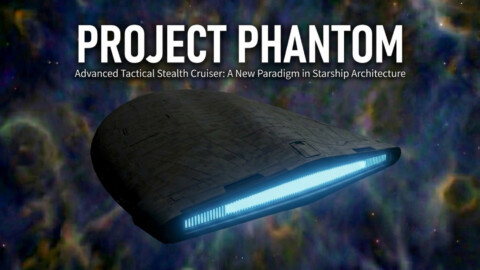
A ship that has cast off its chronic illness, "PHANTOM"